
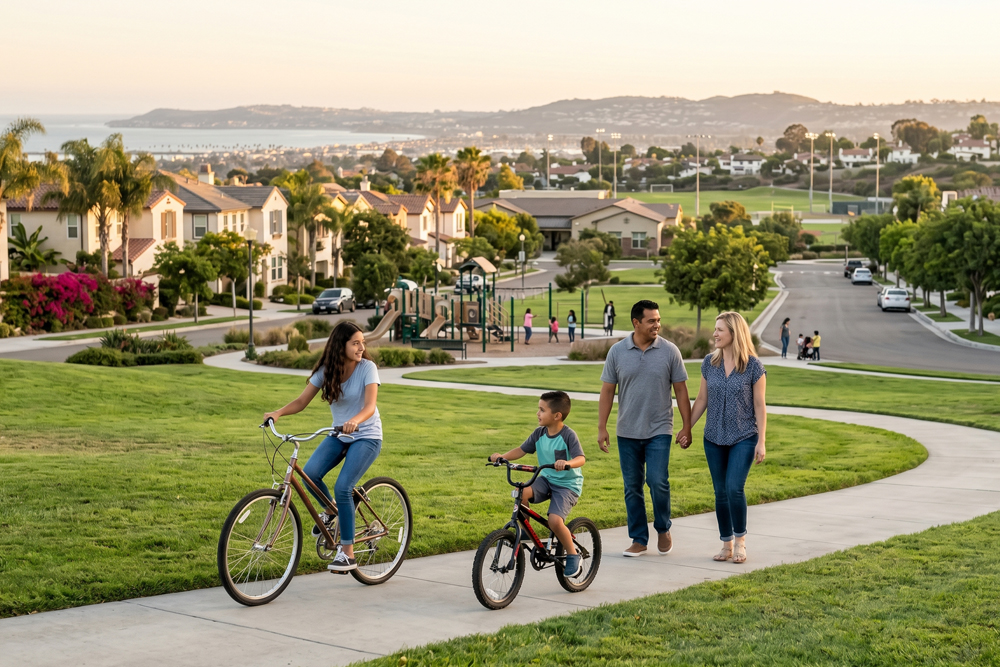
Choosing a family neighborhood in San Diego is not just a real estate decision. It is a lifestyle decision, a financial decision, and in many ways, a psychological decision. Parents are not only asking, “Can we afford this home?” They are asking deeper questions: Will our kids feel safe here? Will the school environment fit them? Will our daily routine feel easier or harder? Will this neighborhood still make sense five, seven, or ten years from now?
San Diego gives families a rare mix of coastal living, suburban comfort, outdoor recreation, strong community pockets, and long-term real estate demand. But that also makes the decision more complex. Two homes with similar square footage can create completely different lives depending on commute routes, school boundaries, street layout, park access, walkability, neighborhood culture, and future resale demand.
For 2026 buyers, the best family neighborhoods in San Diego are not only the ones with attractive homes. They are the neighborhoods that reduce stress, support routines, hold long-term value, and match the way your family actually lives.
What Makes a Neighborhood “Family-Friendly” in 2026?
A family-friendly neighborhood used to be defined mostly by school ratings and quiet streets. Those still matter, but modern buyers are looking at a wider set of signals. Families want convenience, emotional comfort, safety, flexibility, and value protection.
A neighborhood may look perfect during a weekend open house, but the real test is what it feels like on a Monday morning, a Wednesday evening, or a busy Saturday when sports, groceries, school pickups, work calls, and family time all collide.
That is why smart buyers should look beyond the listing photos and evaluate the neighborhood as a living system. The best areas tend to offer a strong combination of:
- Access to well-regarded schools or flexible school options
- Safe, comfortable streets for walking, biking, and outdoor play
- Reasonable commute patterns for working parents
- Parks, libraries, recreation centers, beaches, or trails nearby
- A strong sense of neighborhood identity and community pride
- Homes that fit both current needs and future life stages
- Long-term buyer demand for future resale strength
The most important point is fit. A great neighborhood for one family may feel wrong for another. A family with young children may prioritize parks and elementary schools. A family with teenagers may care more about high school programs, transit, sports access, and room for independence. A family with two remote-working parents may value floor plans, quiet streets, and nearby coffee shops more than commute distance.
The Psychology of Choosing the Right Family Neighborhood
Real estate decisions are emotional, even when buyers think they are being purely logical. Families often choose a home because it “feels right,” then use data afterward to justify the feeling. That is not necessarily bad, but it can lead to mistakes when emotion overpowers strategy.
The strongest buyers use both psychology and data. They notice how a neighborhood makes them feel, then verify whether that feeling is supported by practical evidence.
The Familiarity Bias
Many buyers gravitate toward neighborhoods they already know. Maybe they grew up nearby, have friends in the area, or drive through often. Familiarity creates comfort, but it can also narrow the search too much. A family may overlook a better fit simply because it is not already part of their routine.
For example, someone focused only on coastal San Diego may miss excellent inland family neighborhoods with more space, stronger community feel, or better value. Someone focused only on newer master-planned areas may miss older neighborhoods with character, mature trees, and stronger location convenience.
The “Perfect Home” Trap
Families sometimes fall in love with a house and compromise too much on the neighborhood. The kitchen looks beautiful, the backyard is staged well, and the bedroom count works. But after moving in, the family realizes the commute is draining, the school logistics are difficult, or the street does not support the lifestyle they imagined.
A home can be remodeled. A floor plan can sometimes be improved. But the neighborhood, street location, school boundary, traffic pattern, and surrounding environment cannot be changed by the buyer. For families, the area around the home often matters as much as the home itself.
The Future-Self Test
One of the smartest ways to buy is to ask: “Will this neighborhood still work for us three life stages from now?” A young family may be thinking about strollers and playgrounds today, but soon they may need room for bikes, school projects, sports gear, teen independence, visiting grandparents, or home office needs.
The best family neighborhoods in San Diego tend to support multiple stages of family life. They are not just good for one season. They allow a family to grow into the area rather than outgrow it too quickly.
Best Family Neighborhoods in San Diego for 2026 Buyers
San Diego has many strong family communities, and the right choice depends on budget, lifestyle, school priorities, commute needs, and long-term goals. The neighborhoods below consistently stand out for families because they offer some combination of school access, community feel, recreation, safety, value stability, and lifestyle quality.
Carmel Valley
Carmel Valley remains one of the most sought-after family neighborhoods in San Diego. It is known for newer homes, strong school appeal, clean master-planned streets, parks, shopping centers, and convenient access to coastal areas, Sorrento Valley, Del Mar, and major employment hubs.
For families, the biggest draw is balance. Carmel Valley feels suburban without feeling isolated. Parents often like the organized layout, the access to youth activities, and the sense that the neighborhood was designed with families in mind.
From a data perspective, Carmel Valley tends to attract consistent buyer demand because it combines schools, location, newer housing stock, and proximity to major job centers. From a psychology perspective, it offers buyers a sense of control. Streets feel planned, amenities are nearby, and daily routines can feel more predictable.
The tradeoff is price. Buyers should expect competition and should evaluate whether the premium is worth it for their specific lifestyle. For many families, it is. For others, nearby communities may offer better space or value.
Scripps Ranch
Scripps Ranch is a strong option for families who want a quieter, more established neighborhood with trees, parks, larger homes, and a community-oriented atmosphere. It has a different feel than Carmel Valley. It is less coastal and less new, but it offers warmth, space, and a strong residential identity.
Families are often drawn to Scripps Ranch because it feels calm without feeling disconnected. There are trails, community events, local sports, and a neighborhood culture that appeals to buyers who want stability.
The psychology of Scripps Ranch is important. It often gives buyers the feeling of “settling in” rather than “passing through.” For families looking for long-term roots, that emotional factor matters.
Buyers should compare micro-locations carefully. Some homes offer easier freeway access, while others provide more privacy and neighborhood quiet. The best choice depends on whether commute convenience or residential calm is the higher priority.
Del Sur and 4S Ranch
Del Sur and 4S Ranch are popular with families who want newer homes, community parks, planned amenities, and a polished suburban environment. These areas are often attractive to buyers who want a clean, organized setting with neighborhood events, pools, sports fields, and highly active family life.
The appeal is lifestyle design. These communities make it easier for families to connect with other families, keep children active, and build routines around nearby amenities. For buyers moving from out of the area, that can reduce uncertainty and make the transition easier.
From a buyer psychology standpoint, Del Sur and 4S Ranch reduce decision fatigue. Parks, schools, shopping, and community spaces are built into the rhythm of the neighborhood. That sense of structure can be very comforting for families.
The tradeoff is that buyers should be mindful of commute patterns, HOA rules, lot sizes, and home-to-home density. A newer community can be extremely convenient, but families should make sure the physical layout fits their daily life.
Rancho Peñasquitos
Rancho Peñasquitos is a practical, family-oriented choice for buyers who want access to established neighborhoods, outdoor recreation, and a strong residential feel. It is often considered by families who like North County convenience but want a slightly different price and lifestyle profile than Carmel Valley or Del Sur.
The neighborhood offers access to parks, trails, and a suburban pace that many families appreciate. It can be especially appealing to buyers who want a balance between space, schools, commute access, and long-term livability.
One of the advantages of Rancho Peñasquitos is that it does not feel like a single type of neighborhood. Different pockets offer different home styles, lot sizes, and street patterns. Buyers should look carefully at each pocket instead of judging the area as one broad category.
Poway
Poway is often called “The City in the Country,” and that identity matters. Families who choose Poway often want more space, a quieter lifestyle, and a community that feels separate from the intensity of central San Diego.
Poway can be especially attractive to buyers who want larger lots, strong school appeal, access to hiking and outdoor activities, and a more traditional suburban environment. It may be a better fit for families who value privacy, room to grow, and a slower daily pace.
The emotional appeal of Poway is rooted in breathing room. For families leaving denser neighborhoods, that extra space can feel like a major quality-of-life upgrade.
The tradeoff is commute. Buyers should test drive work routes during real commute hours before committing. A home may feel perfect on Sunday afternoon but very different on Tuesday morning.
Tierrasanta
Tierrasanta is a strong central option for families who want a residential feel without moving too far north or east. It offers canyons, trails, parks, and a quieter atmosphere while still giving buyers access to major parts of San Diego.
Families often like Tierrasanta because it feels tucked away. It has a neighborhood feel that can be hard to find in more urban areas. For buyers who want community, convenience, and access to nature, it deserves serious consideration.
The psychology of Tierrasanta is about escape. Many families like that they can be close to the city but still feel removed from noise and congestion. That emotional separation can improve daily quality of life.
Clairemont and Bay Park
Clairemont and Bay Park are excellent options for families who want central location, older homes, renovation potential, and access to beaches, Mission Bay, freeways, and urban amenities. These neighborhoods can appeal to buyers who care about lifestyle flexibility more than master-planned polish.
Clairemont offers a wide range of home types and price points compared with some of San Diego’s more premium family areas. Bay Park adds view potential, proximity to the bay, and a lifestyle that blends family living with coastal convenience.
For data-minded buyers, these areas are interesting because central location tends to remain valuable over time. For psychology-minded buyers, they offer a sense of possibility. Many homes can be improved, personalized, and turned into long-term family properties.
Buyers should pay close attention to street-by-street differences. One block may feel quiet and residential, while another may be closer to traffic, commercial activity, or freeway noise.
La Mesa
La Mesa is a strong choice for families who want charm, community, relative value, and access to both San Diego and East County. It offers older homes, walkable pockets, village-style areas, parks, and a warmer neighborhood personality.
For families priced out of some coastal or North County communities, La Mesa can offer a compelling mix of livability and value. It may not have the same prestige perception as some higher-priced areas, but many buyers find that the day-to-day experience fits their family extremely well.
Psychologically, La Mesa appeals to buyers who want authenticity. The homes and streets often feel less manufactured and more established. That can be a major advantage for families who want character and community over newer construction.
South Park and North Park
South Park and North Park are not the traditional choice for every family, but they can be excellent for buyers who value walkability, culture, restaurants, parks, historic homes, and a more urban lifestyle. These neighborhoods are often a better fit for families who want energy and convenience instead of a purely suburban setting.
Families who thrive here often like being close to Balboa Park, local businesses, coffee shops, schools, and community events. The lifestyle is different from Carmel Valley or Poway, but for the right buyer, it can be more fulfilling.
The key is honest self-awareness. Some families love walkable urban living. Others find parking, density, noise, or smaller lots stressful. Neither preference is wrong. The right choice depends on the family’s real daily behavior, not an idealized version of what they think they should want.
Encinitas and Carlsbad
Although Encinitas and Carlsbad are outside the City of San Diego, many San Diego family buyers include them in the search because they offer coastal lifestyle, schools, parks, beaches, and strong community appeal.
Encinitas often attracts families who want a relaxed coastal identity, outdoor living, and a strong lifestyle connection to the beach. Carlsbad appeals to many buyers who want master-planned convenience, family amenities, shopping, sports, and a slightly broader range of housing options.
The tradeoff is budget and commute. These areas can be expensive, and buyers working in central San Diego should carefully evaluate drive times. Still, for families who prioritize coastal living and long-term lifestyle value, they remain highly desirable.
How to Compare Neighborhoods Using Data
The best family neighborhood is not always the one with the highest price or the most famous name. Buyers should compare neighborhoods using practical data points that connect directly to quality of life.
School Fit, Not Just School Ratings
School ratings can be helpful, but they are not the whole story. Families should look at programs, campus culture, special education resources, extracurriculars, commute time, enrollment rules, and whether the school environment fits the child’s personality.
A school that is perfect for one child may not be ideal for another. Data should support the decision, not replace parental judgment.
Commute Friction
Commute time is one of the most underestimated family stress factors. A neighborhood that adds 20 minutes each way can change dinner routines, sleep schedules, exercise habits, and overall family patience.
Smart buyers should test commute routes during real traffic windows. Do not rely only on map estimates during off-hours. The emotional cost of a commute can be just as important as the financial cost of a mortgage.
Street Quality
Families should evaluate the specific street, not just the neighborhood. Look at traffic speed, sidewalks, lighting, parking, noise, slope, visibility, and how comfortable it feels for children to walk or bike.
Two homes in the same neighborhood can produce very different family experiences if one sits on a quiet interior street and the other sits near a busy cut-through route.
Access to Daily Needs
A family-friendly neighborhood should make daily life easier. Grocery stores, pharmacies, parks, coffee shops, childcare, medical offices, sports fields, and after-school activities all matter.
The question is not only “What is nearby?” The better question is, “How often will we use it, and how much stress will it remove from our week?”
Resale Demand
Even if a buyer plans to stay long-term, resale should still matter. Life changes. Jobs shift. Families grow. Aging parents move in. Children move out. A home in a neighborhood with broad buyer demand gives the family more flexibility.
Strong resale neighborhoods often have a mix of school appeal, location convenience, lifestyle amenities, and limited supply. Buyers should consider whether future families will want the same things they value today.
The Sunday Test: A Simple Way to Feel the Neighborhood
Before writing an offer, families should spend time in the neighborhood outside of the showing appointment. Visit on a weekday morning, a weekday evening, and a Sunday afternoon. Each time reveals something different.
On a weekday morning, you can observe traffic, school drop-off patterns, and noise. On a weekday evening, you can see parking, neighbor activity, and commute return flow. On Sunday afternoon, you can feel the lifestyle. Are families outside? Are parks active? Do people walk dogs? Does the neighborhood feel relaxed, isolated, busy, or connected?
This matters because buyers often make decisions in staged environments. A home showing is controlled. Real neighborhood life is not. The more time a buyer spends observing real patterns, the better the decision becomes.
Common Mistakes Family Buyers Should Avoid
Buying a family home in San Diego can be competitive, emotional, and expensive. Avoiding the wrong decision is just as important as finding the right opportunity.
- Chasing reputation only: A famous neighborhood is not automatically the best fit for your family.
- Ignoring commute reality: A beautiful home can become stressful if the daily drive damages family routines.
- Overvaluing cosmetic upgrades: New countertops matter less than location, layout, light, street quality, and long-term function.
- Not checking school boundaries: Boundaries, programs, and enrollment options should always be verified before making a decision.
- Underestimating future needs: A home that works for toddlers may not work for teenagers, visiting family, or remote work.
- Skipping neighborhood visits: A showing tells you about the property. Repeated visits tell you about the lifestyle.
How 2026 Buyers Should Think About Budget
San Diego remains one of the most desirable and competitive housing markets in California. For family buyers, budget should not be treated as only a purchase price question. It should include the full cost of living in the neighborhood.
That means property taxes, insurance, HOA fees, maintenance, utility costs, commute costs, renovation needs, childcare logistics, and lifestyle expenses. A slightly less expensive home far from daily needs may not actually feel less expensive once time and stress are included.
The smartest buyers build a comfort range, not just a maximum number. The top of the budget may be possible on paper, but the better question is whether it allows the family to live well after closing.
Which San Diego Family Neighborhood Is Best for You?
The answer depends on your family’s priorities.
If you want newer homes, organized amenities, and strong family infrastructure, Carmel Valley, Del Sur, 4S Ranch, and parts of Carlsbad may be a strong fit. If you want established neighborhoods, trees, parks, and a rooted community feel, Scripps Ranch, Rancho Peñasquitos, Poway, and Tierrasanta deserve attention.
If you want central convenience and long-term location strength, Clairemont and Bay Park may be smart options. If you want charm, value, and community character, La Mesa may be worth exploring. If you want walkability and culture, South Park and North Park may offer the lifestyle your family actually enjoys.
The best choice is not about copying another family’s decision. It is about matching your budget, routines, values, school needs, commute tolerance, and long-term plans with the neighborhood that supports them best.
How We Can Help
Triolo Realty helps buyers make smarter real estate decisions by combining market data, neighborhood knowledge, buyer psychology, and strategic guidance. Led by Darin Triolo, our team understands that a family home is more than a transaction. It is where routines are built, memories are made, and long-term wealth decisions take shape.
If you are searching for the best family neighborhoods in San Diego, we can help you compare areas clearly, understand pricing patterns, evaluate lifestyle fit, and avoid emotional mistakes that lead to regret. Whether you are buying your first family home, moving up, relocating to San Diego, or trying to choose between several neighborhoods, Triolo Realty can guide you with clarity, strategy, and a higher level of care from the first conversation to the final closing.






 Each office is independently owned and operated. This information is deemed reliable but not guaranteed. You should rely on this information only to decide whether or not to further investigate a particular property. BEFORE MAKING ANY OTHER DECISION, YOU SHOULD PERSONALLY INVESTIGATE THE FACTS (e.g. square footage and lot size) with the assistance of an appropriate professional. You may use this information only to identify properties you may be interested in investigating further. All uses except for personal, non-commercial use in accordance with the foregoing purpose are prohibited. Redistribution or copying of this information, any photographs or video tours is strictly prohibited. This information is derived from the Internet Data Exchange (IDX) service provided by San Diego MLS. Displayed property listings may be held by a brokerage firm other than the broker and/or agent responsible for this display. The information and any photographs and video tours and the compilation from which they are derived is protected by copyright. Compilation © 2024 San Diego MLS, Inc. Licensed in the state of California.